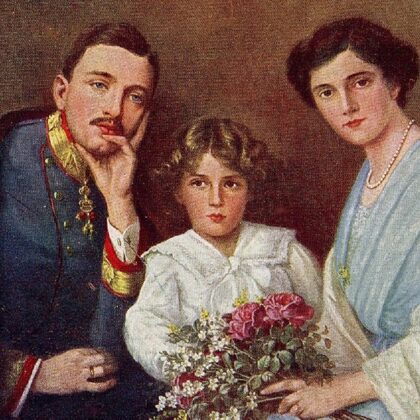
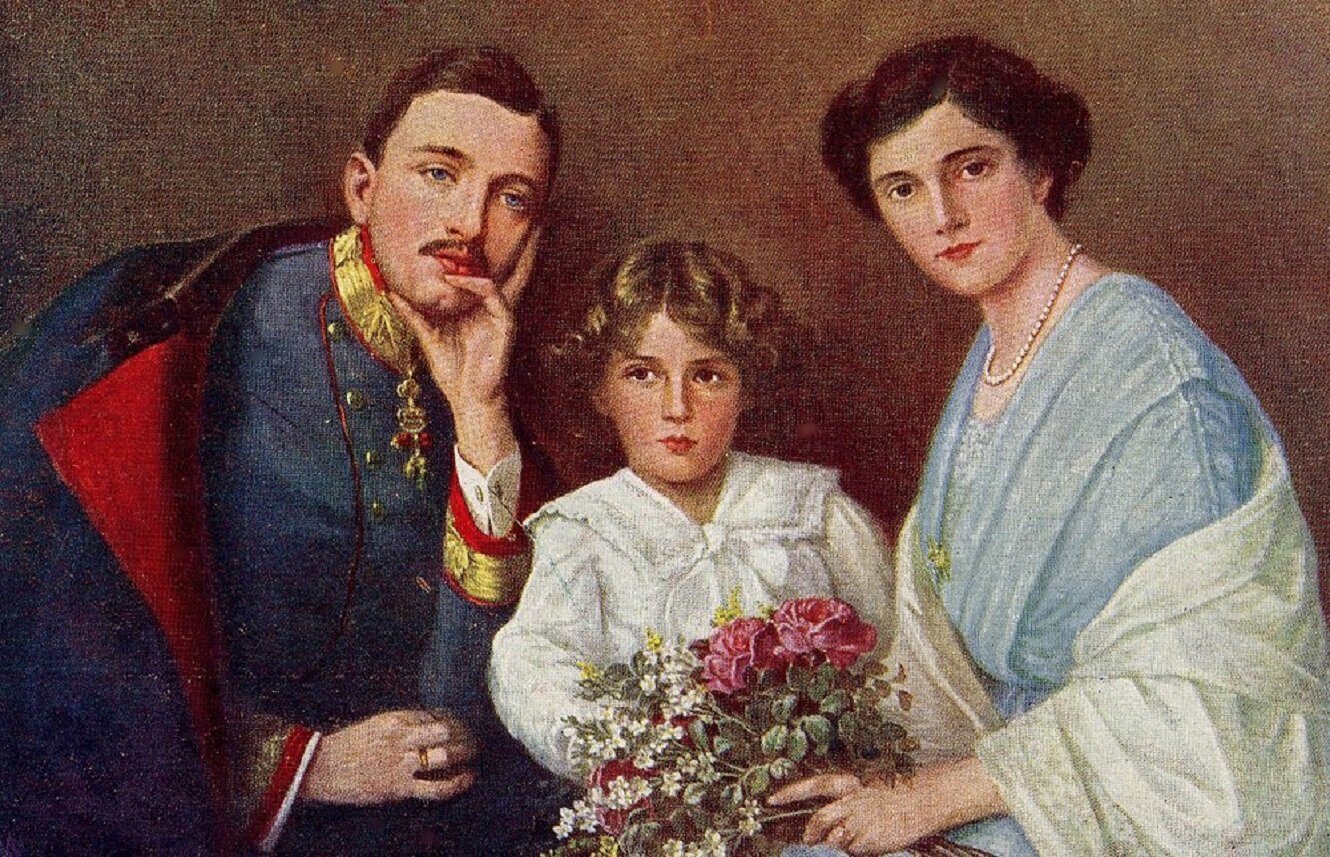
EMPEROR CHARLES I (KARL I)(1887-1922) ,KARL FRANZ JOSEPH LUDWIG HUBERT GEORG OTTO MARIA AND EMPRESS ZITA OF BOURBON - PARMA (1892-1989),THE LAST MONARCH BELONGING TO THE HOUSE OF HABSBURG - LORRAINE BEFORE THE DISSOLUTION OF AUSTRIA - HUNGARY .AFTER HIS UNCLE ARCHDUKE FRANZ FERDINAND OF ASSASSINATED IN 1914.
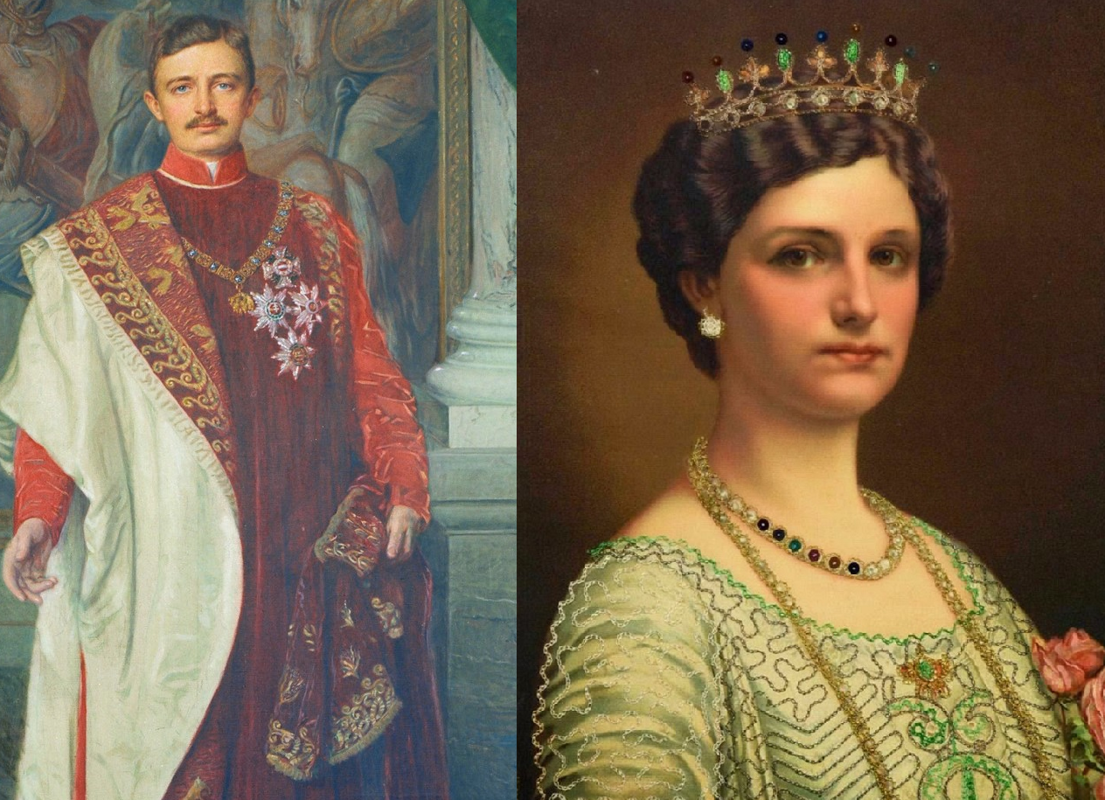 Emperor Karl is the only decent man to come out of the war in a leadership position, no one listened to him. He sincerely wanted peace, and therefore was despised by the whole world. It was a wonderful chance that was lostBlessed Karl was a happy married man. On his wedding day, he famously declared to his beautiful wife, Zita, “Now we have to help each other to get to heaven!” They were even more devoted to God than to each other and they inscribed their relationship with God into their daily lives together. Blessed Karl proposed to his lovely Zita at the Shrine of Mariazell in Austria and they inscribed a prayer inside their wedding bands, “Sub tuum presidium confugimus, sancta Dei Genitrix” (We fly to take refuge under your protection, O Holy Mother of God). Their love was intense and lasted to the end of Karl’s life. For her part, the Empress Zita never remarried but continued to carry the memory of her husband and she blessed others with the title she had received from him.
Charles I or Karl I (Karl Franz Joseph Ludwig Hubert Georg Otto Maria was the last Emperor of Austria, the last King of Hungary;, and the last monarch belonging to the House of Habsburg-Lorraine before the dissolution of Austria-Hungary. After his uncle Archduke Franz Ferdinand of Austria was assassinated in 1914,he is known to the Catholic Church as Blessed Karl of Austria. He was the last Emperor of Austria, the last King of Hungary (as Charles IV), and the last monarch belonging to the House of Habsburg-Lorraine. After his uncle Franz Ferdinand was assassinated in 1914, Charles became the designated successor of the Emperor Franz Josef. Charles I reigned from 1916 until 1918, when he "renounced participation" in state affairs, but did not abdicate. He spent the remaining years of his life attempting to restore the monarchy until his death in 1922. Following his beatification by the Catholic Church in 2004, within Catholic community he is commonly known as Blessed Karl of Austria.Karl was born on August 17, 1887, at the Castle of Persenbeug in Lower Austria. As he was the great-nephew of the then ruling Emperor, Franz Joseph, it was not envisioned at his birth that it would one day fall to him to rule. Yet, his education prepared him for the task.Charles parents were Archduke Otto Franz of Austria and Princess Maria Josepha of Saxony. At the time, his granduncle Franz Joseph reigned as Emperor of Austria and King of Hungary, and his uncle Franz Ferdinand became heir presumptive two years later.That as Emperor he would rule wants to be emphasized. The emperors of the Holy Roman Empire and then the Austro-Hungarian one did not merely reign, like the European monarchs who remain today, all of the “constitutional” ones. By the time of Karl’s accession their power was no longer absolute as it still was with the Russian Tsar, but it was real. None was a figurehead unless rendered so by personal incapacity.As a child, Archduke Charles was reared a devout Roman Catholic. He spent his early years wherever his father's regiment happened to be stationed; later on he lived in Vienna and Reichenau an der Rax. He was privately educated, but, contrary to the custom ruling in the imperial family, he attended a public gymnasium for the sake of demonstrations in scientific subjects. On the conclusion of his studies at the gymnasium, he entered the army, spending the years from 1906 to 1908 as an officer chiefly in Prague, where he studied law and political science concurrently with his military duties.In 1907, he was declared of age and Prince Zdenko Lobkowitz was appointed his chamberlain. In the next few years he carried out his military duties in various Bohemian garrison towns. Charles's relations with his granduncle were not intimate, and those with his uncle Franz Ferdinand were not cordial, with the differences between their wives increasing the existing tension between them. For these reasons, Charles, up to the time of the assassination of his uncle in 1914, obtained no insight into affairs of state, but led the life of a prince not destined for a high political position.Charles became heir presumptive after the assassination of Archduke Franz Ferdinand in Sarajevo in 1914, the event which precipitated World War I. Only at this time did the old Emperor take steps to initiate the heir-presumptive to his crown in affairs of state. But the outbreak of World War I interfered with this political education. Charles spent his time during the first phase of the war at headquarters at Teschen, but exercised no military influence.Charles then became a Feldmarschall (Field Marshal) in the Austro-Hungarian Army. In the spring of 1916, in connection with the offensive against Italy, he was entrusted with the command of the XX. Corps, whose affections the heir-presumptive to the throne won by his affability and friendliness. The offensive, after a successful start, soon came to a standstill. Shortly afterwards, Charles went to the eastCharles succeeded to the thrones in November 1916, after the death of his grand-uncle, Emperor Franz Joseph.On 2 December 1916, he assumed the title of Supreme Commander of the whole army from Archduke Friedrich. His coronation as King of Hungary occurred on 30 December. In 1917, Charles secretly entered into peace negotiations with France. He employed his brother-in-law, Prince Sixtus of Bourbon-Parma, an officer in the Belgian Army, as intermediary. However, the Allies insisted on Austrian recognition of Italian claims to territory and Charles refused, so no progress was made.Although his foreign minister, Graf Czernin, was only interested in negotiating a general peace which would include Germany, Charles himself went much further in suggesting his willingness to make a separate peace. When news of the overture leaked in April 1918, Charles denied involvement until French Prime Minister Georges Clemenceau published letters signed by him. This led to Czernin's resignation, forcing Austria-Hungary into an even more dependent position with respect to its seemingly wronged German ally.The Austro-Hungarian Empire was wracked by inner turmoil in the final years of the war, with much tension between ethnic groups. As part of his Fourteen Points, U.S. President Woodrow Wilson demanded that the Empire allow for autonomy and self-determination of its peoples. In response, Charles agreed to reconvene the Imperial Parliament and allow for the creation of a confederation with each national group exercising self-governance. However, the ethnic groups fought for full autonomy as separate nations, as they were now determined to become independent from Vienna at the earliest possible moment.Foreign minister Baron Istvan Burián asked for an armistice 14 October based on the Fourteen Points, and two days later Charles issued a proclamation that radically changed the nature of the Austrian state. The Poles were granted full independence with the purpose of joining their ethnic brethren in Russia and Germany in a Polish state. The rest of the Austrian lands were transformed into a federal union composed of four parts: German, Czech, South Slav, and Ukrainian. Each of the four parts was to be governed by a federal council, and Trieste was to have a special status. However, Secretary of State Robert Lansing replied four days later that the Allies were now committed to the causes of the Czechs, Slovaks and South Slavs. Therefore, autonomy for the nationalities was no longer enough. In fact, a Czechoslovak provisional government had joined the Allies 14 October, and the South Slav national council declared an independent South Slav state 29 October 1918.ern front as commander of an army operating against the Russians and Romanians.

 The family's first home in exile was Wartegg Castle in Rorschach, Switzerland, a property owned by the Bourbon-Parmas. However, the Swiss authorities, worried about the implication of the Habsburgs living near the Austrian border, compelled them to move to the western part of the country. The next month, therefore, found them moving to Villa Prangins, near Lake Geneva, where they resumed a quiet family life. This abruptly ended in March 1920 when, after a period of instability in Hungary, Miklós Horthy was elected regent. Charles was still technically King (as Charles IV) but Horthy sent an emissary to Prangins advising him not to go to Hungary until the situation had calmed. After the Trianon Treaty Horthy's ambition soon grew. Charles became concerned and requested the help of Colonel Strutt to get him into Hungary. Charles twice attempted to regain control, once in March 1921 and again in October 1921. Both attempts failed, despite Zita's staunch support (she insisted on travelling with him on the final dramatic train journey to Budapest.