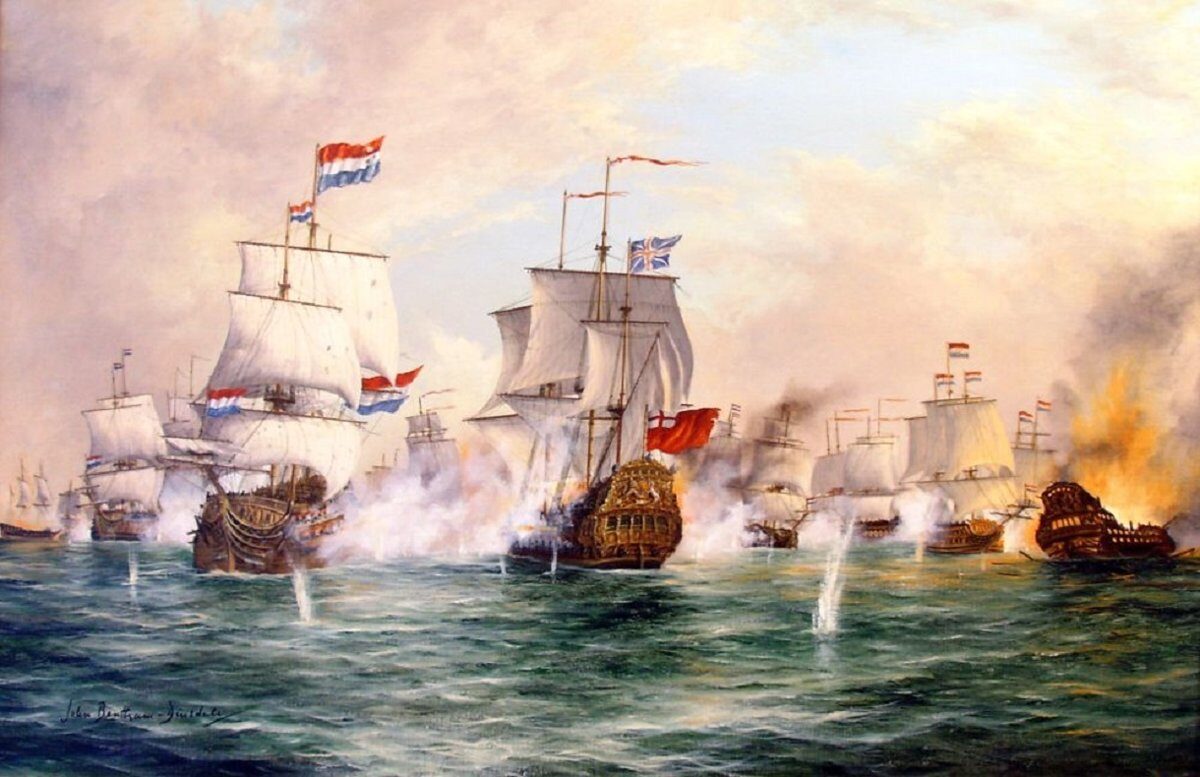
THE BATTLE OF SOLEBAY WAS OPENING BATTLE OF THE THIRD ENGLAND AND THE NETHERLAND WAR (1672-74).THEY FOUGHT THREE NAVAL WARS IN THE MIDDLE OF THE 17TH CENTURY WRITING PRINCIPALLY FROM A CLASH OF MERCANTILE INTERESTS.
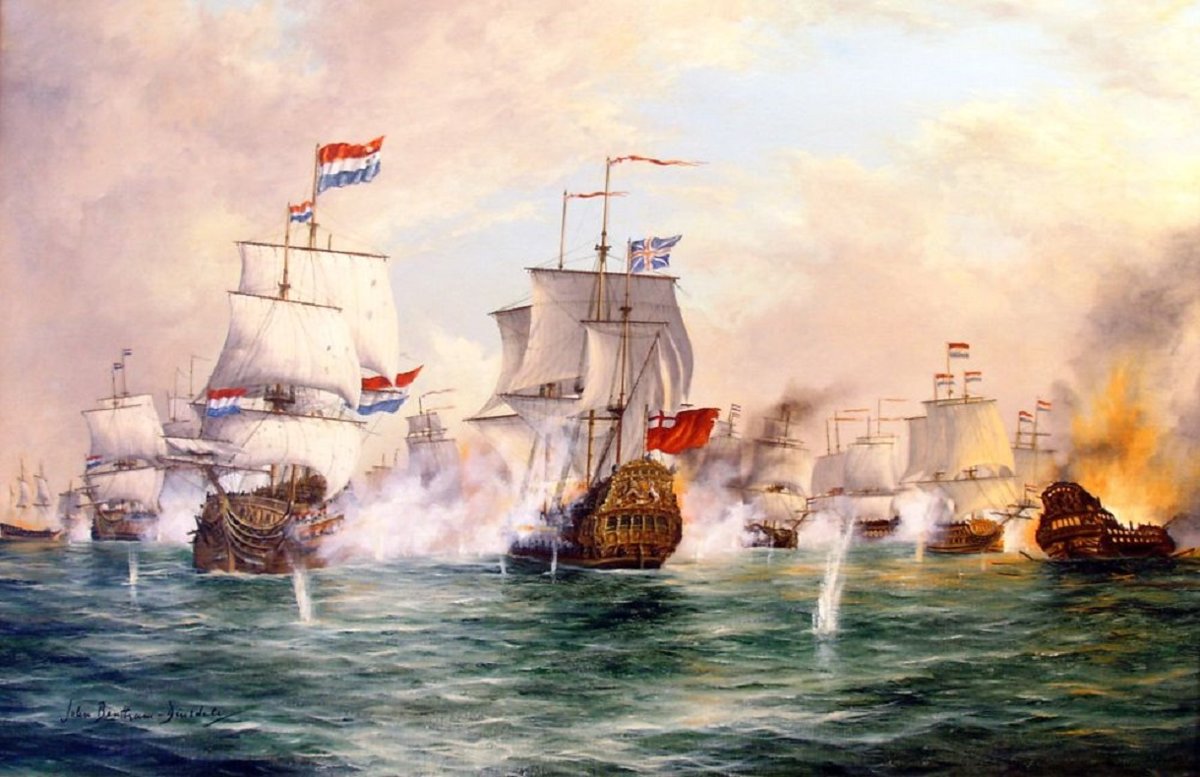 The naval Battle of Sole Bay, 1672 . The Battle of Sole Bay, was a bloody but indecisive naval battle fought off Southwold, Suffolk, between the English and French on one side and the Dutch on the other in 1672.Where Sir Charles Harbord died holding off the Dutch Fleet for 6 Hours, to allow the English Fleet to set sail from the bay and join the battle rather than being sunk, like those at Pearl Harbour years later.
The Netherlands and England were both great maritime nations and it was inevitable that a conflict would arise between then. There were three Anglo-Dutch Wars. The first from 1652 to 1654, the second from 1664 to 1667 and the third from 1672-1674. It was the end of the second war that gave the British New Amsterdam. The Third Anglo-Dutch War was part of the Franco-Dutch War (1672-1674), waged by Louis XIV of France who sought control of the Spanish Netherlands.The allied fleet had assembled in Sole Bay to carry out repairs and take on supplies before moving on to a strategic position to blockade the Dutch ports. The Dutch contingent had already made one foray to find the English fleet, but arrived in the Medway in thick fog, allowing the English, who were unaware of the Dutch presence, to sail north to Southwold.In the early hours of 28th May, 1672, a French frigate sailed into the bay with the news that the Dutch fleet had been sighted and were just a few hours away. Most of the crews were enjoying shore leave in the various taverns and inns of Southwold, Dunwich and Walberswick when battle was declared. It took the Baliffs and a drummer boy four hours to clear the sailors out of the taverns and back on to their ships.The Dutch fleet was under the command of Admiral Michiel Adriaenzoon de Ruyter aboard the ship Zeven Provincien. The Admiral played a significant part in all three of the Anglo-Dutch wars. He commanded around 75 ships, 36 fireships*, 4,484 guns and around 20,732 men. His Lieutenant Admirals were Adriaen Banckert and Willem Joseph van Ghent.The Anglo-French fleet was under the command of James, Duke of York, later to become James II, aboard the Royal Prince as Admiral of the Red. His side-lieutenants were Edward Montagu, Earl of Sandwich, Admiral of the Blue, aboard the newest and biggest ship in the English fleet, the Royal James. On the French side was Comte Jean II d’Estrées, Admiral of the White, aboard Sainte Philippe. The allied fleet had around 71 ships, plus frigates and fireships*, over 5,500 guns and 24,000 men.James, Duke of York, and the Earl of Sandwich, had both spent the night prior to the battle at their Headquarters, Sutherland House, in Southwold’s High Street one of the few buildings to have escaped the terrible fire of 1659.By the time most of the sailors were rounded up and the ships were ready to put to sea, it was 5.30am. The French fleet, anchored off Dunwich, were intended to be in front, but the approach by the Dutch from an unexpected direction meant that they found themselves in the rear. Interestingly, the French fleet turned south, away from the battle, but they were pursued by Banckert who inflicted heavy casualties. It is thought that Louis XIV had given secret orders to Vice Admiral Comte d’Estrées to avoid battle if he could, in the hope that the English and Dutch would destroy each other to the benefit of the French. However, towards the end of the battle, the French responded to the firing from Banckert, and headed north again in pursuit of the Dutch.The Dutch had divided their fleet into small units, and by 8am, the English fleet had become spread out and individual ships became easy targets to pick out. The English were unable to form tight formations and therefore couldn’t deliver effective broadsides. The Earl of Sandwich’s flagship, the Royal James, was attacked by Groot Hollandia (captained by Jan van Brakel) which attached itself to the Royal James and repeatedly canoned the hull. The Earl ordered parties from other ships to board the Groot Hollandia, forcing the Dutch captain to cut the lines and retreat. The Royal James drifted away, sinking, and was attacked by several fireships. The ship burnt with a great loss of life. The Earl’s body was found weeks later, only recognisable by his scorched clothing still bearing the Order of the Garter.The Duke of York had to move his flag (of course, he was a prime target for the Dutch) twice – from the vessels Prince, St Michael, and finally to London.The battle lasted for most of the day, and in the thick smoke, noise and confusion, losses were heavy. It ended at sunset, where the failing light and the possible return of the French caused the Dutch fleet to withdraw. The Dutch lost two ships and 1,800 men, the English lost two ships and about 2,000 men. For weeks afterwards, the Southwold Chamberlain’s accounts record payments of a shilling to anyone who found and buried the body of a drowned sailor. Over 800 wounded men from all sides were landed at Southwold.Both sides claimed victory, but the Dutch probably gained most from the encounter. The Dutch lost four vessels (two were captured as prizes, one was sunk, the other blew up) but they had successfully prevented the English fleet from blockading the Dutch ports and couldn’t support a French landing off Holland.In the first of these, under the Commonwealth, England had much the better, due largely to the outstanding leadership of Robert Blake. The second war was more even. By now Charles II had been restored to the throne. There were a number of fierce battles which went either way, but the war ended with the humiliation of the Dutch burning a large part of the English fleet in the Medway. After reviewing the earlier wars, this book goes on to describe the third Anglo Dutch war, fought between 1672 and 1674. This war of shameless aggression was provoked by England, or rather by King Charles and his court, mainly as a matter of commercial greed. It began, before any declaration of war, with an attack on a Dutch merchant convoy proceeding up-Channel. In this war, for the first time, England fought in alliance with France, and the French fleet was an important, if ultimately ineffective, part of the fleet which under the leadership first of the Earl of Sandwich, then by James, Duke of York, and finally by Prince Rupert, took on the Dutch fleet led by the brilliant Admiral Michiel de Ruyter. At Solebay on the Suffolk coast, de Ruyter surprised the English fleet on the morning of 28 May 1672; in the intense fighting Sandwich’s flagship, the Royal James was blown up and he was killed. Overall, the Dutch could claim it as a victory. There later followed in 1673 two battles off Schooneveld and then the battle of the Texel. In this fight the French treacherously hung back. De Ruyter’s tactical skill in these battles ensured that a planned attempt at invasion was prevented. The war ended with the Allies by no means in unison, and Charles II, obliged by lack of funds to make peace, had nothing to show for a war that should never have been fought.
 The third Anglo-Dutch War was fought as part of a complicated series of hostilities between England, France, the Netherlands and Sweden. England was at first part of a triple alliance with Sweden and the Netherlands against France. However, Charles made a secret deal with France, and France attempted to invade the Netherlands. At this point, England joined France and was briefly at war until a peace was made separately between France and the Netherlands. Overall England was not pleased with the course of events, and again made peace, but not until William III of Orange, a nephew of Charles III who had been excluded from power in the Netherlands for many years, was named "Stadtholder", after the assassination of his rival Johan de Witt. Fifteen years later, William of Orange became William III of England.
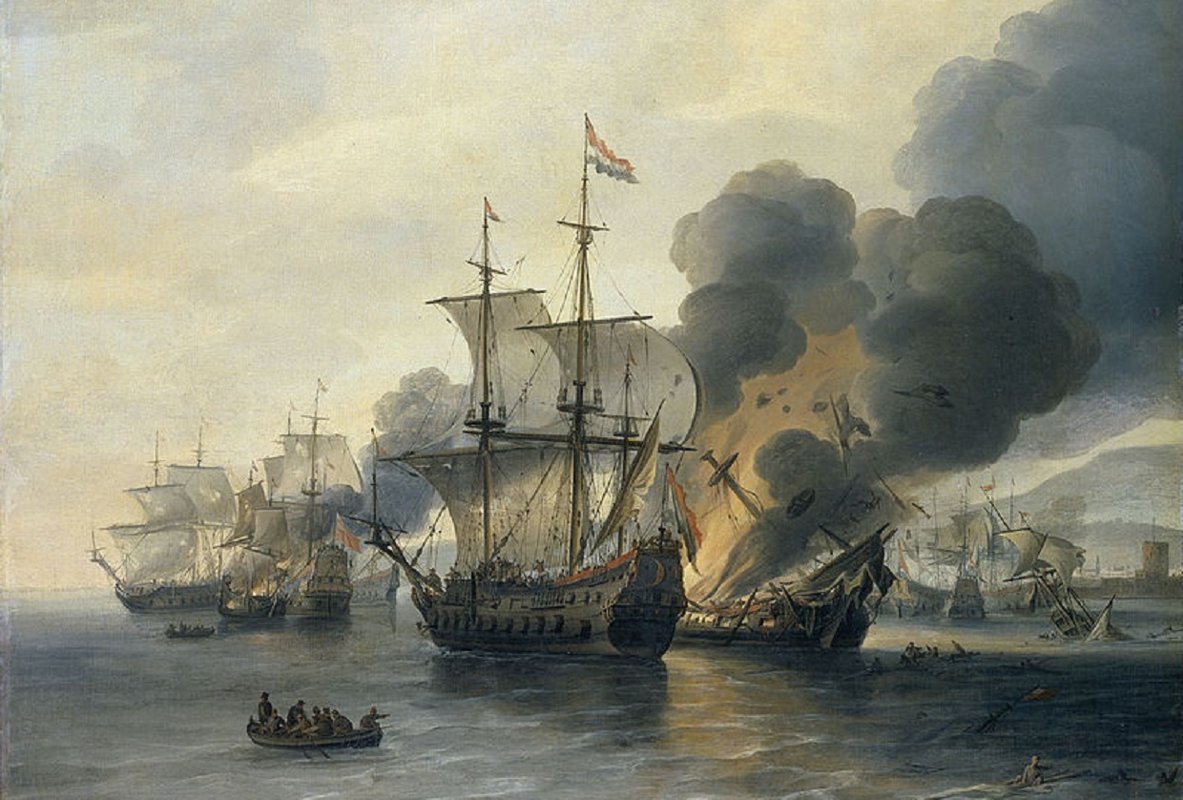
The war had been deliberately provoked by the British, after Charles II came to an agreement with Louis XIV of France. The allies planned a two-pronged assault on the Netherlands. While one French army invaded from the Spanish Netherlands, a joint Anglo-French fleet would land a second army on the Dutch coast, bypassing the United Provinces' water defences.Early in May a French squadron under Admiral D'Estrées joined the British fleet at Portsmouth, and the allied fleet sailed east into the North Sea. The French provided thirty warships and eight fireships, while the British had around sixty-five warships (some sources say fifty five) and twenty two fireships. The Dutch had seventy five ships of the line and frigates, thirty six fireships and a number of smaller ships.The Dutch, under de Ruyter, were already at sea, and on 19 May the two fleets came together off the Essex coast, but the weather prevented a battle. The Allies sailed on to the north and anchored in Solebay, with the French to the south, Edward, Montague earl of Sandwich to the north, and the commander-in-chief, James duke of York, in the centre. Sandwich was worried that the fleet was in danger of being trapped against the shore by the Dutch, but the Duke of York dismissed his fears, believing that the Dutch had sailed over to their own coast after the earlier encounter.This was not the case. Early on the morning of 28 May the Allies were alarmed to discover the Dutch fleet sailing towards them from the north-east. This was potentially the most dangerous moment for the allies – the allies were in disarray, and if the wind had held then the Dutch fireships might have won a crushing victory, but at a key moment the wind dropped.This gave the Allies time to restore order. Sandwich and the Duke of York both moved north-east, gaining valuable room to manoeuvre, but the French squadron headed off to the south-east, possibly because of secret orders from Louis XIV not to take too many risks. De Ruyter responded by splitting his own fleet, sending between twenty and twenty-five of his ships to face the French while the remaining fifty to fifty five headed for the British. The French role after this is controversial. They effectively fought a separate battle out of sight of the British, in which they lost two ships, but French claims of a major part in the battle are unsupported.The main Dutch fleet and the two British squadrons fought in line-of-battle, a distinct change from the melee battles of the First Anglo-Dutch War. Sandwich, with the English rear, was first into action against Van Ghent with the Dutch right/ rear. Sandwich's own flagship, the Royal James, came under attack from the much smaller Groot Hollandia (Jan van Brakel), two fireships and Van Ghent's flagship. Both admirals were killed in the fighting, which ended when a third fireship grappled the Royal James, setting her on fire. After this fight the Dutch rear withdrew from the action for some time, allowing the rest of the British rear to support the Duke of York.In the centre the Dutch attack was so fierce that the Duke of York was eventually forced to move his flag from the Royal Prince to the St Michael. The arrival of the British rear might have given the Duke of York the advantage, but the Dutch right/ rear soon rejoined the fight, and from about 8 pm the battle began to wind down, and after 9 pm the Dutch moved off to the north.The battle ended as a hard-fought draw. The Dutch lost the Stavoren (48) and the Jazua (60), and suffered around 1,600 killed. The British lost the Royal James and one other ship, while the Royal Katherine was briefly captured. British casualties were around 2,500. The French lost two ships. A great number of fireships were used up during the battle, although the Royal James was the only ship to be sunk by a fireship attack.Both fleets had to remain in port for some time for repairs, but the allies were back at sea in June, and at the start of July they even planned to land on Texel, but bad weather prevented this, and the rest of the year passed relatively quietly at sea.De Ruyter, Dutch Admiral, ed Jaap R. Bruijn, Ronald Prud'homme van Reine and Rolof van Hövell tot Westerflier. A collection of interesting essays written by Dutch historians and that examines different aspects of de Ruyter’s life and the wider world of the Dutch Republic. This is a valuable piece of work that helps explain the important of de Ruyter as a European figure (not just as a commander during the Anglo-Dutch Wars.The battle took place against the backdrop of a French invasion of the Netherlands in 1672. Two further naval battles took place at Schooneveld and a third off the Texel in 1673: at the end of the war the Treaty of Westminster ceded New Amsterdam to England, to become the city of New York.The location of the battle is arbitrary and for representative purposes only, based on a location two miles from the shore between Southwold and Aldeburgh in the early stages of the battle.The advice was not taken and the Dutch fleet, commanded by Lieutenant-Admiral Michiel de Ruyter, did appear and attacked Sandwich's unsupported squadron in the bay. Sandwich, in the 'Royal James', 100 guns, was heavily engaged with the squadron of Admiral Van Ghent, who sent in two fireships. The 'Royal James' sank them both but a third fireship, commanded by Jan van de Rijn, grappled the English flagship and set her ablaze. When she was engulfed by the flames Sandwich tried to escape by boat, but it was swamped by people who jumped into her with him and he was drowned. In the left foreground is a Dutch ship sinking, viewed from off the port bow, with only the fore part above the water but with bowsprit and foremast still standing. This is presumably a fireship expended in an attempt to burn the 'Royal James'. In the left background is the de Ruyter's 'Zeven Provincien', 80 guns, in starboard-quarter view with a pendant at the main. She is engaged to port with the English vice-admiral of the blue, Sir Joseph Jordan in the 'Royal Sovereign'. Her blue flag at the fore is shown above the smoke as she stands back towards the 'Royal James' after a vain attempt to weather the Dutch. Ahead of de Ruyter is the rear-admiral of his squadron, J. van Nes in the 'Ridderschap'.The 'Royal James' has her torn topsails set and her fore and main courses have the clews hauled up. Sandwich's blue flag at the main is blowing out in the light wind. Men are shown jumping overboard and hanging to the rigging to avoid the fire both fore and aft. On the right, sailing past the 'Royal James's' port quarter, is a Dutch vice-admiral, viewed from the port bow, with a flag at the fore and pendant at the main. She is under a fore course, a clewed main course, main and mizzen topsails and with her fore topsail much torn and half lowered. In the right foreground is the ship's boat in which the fireship's crew is escaping after setting light to their vessel. The artist was the younger son of Willem van de Velde the Elder. Born in Leiden, he studied under Simon de Vlieger in Weesp and in 1652 moved back to Amsterdam. There he worked in his father's studio and developed the skill of carefully drawing and painting ships in tranquil settings. He changed his subject matter, however, when he came with his father to England in 1672, by working on views of royal yachts, men-of-war and on storm scenes. From 1672 the depiction of sea battles from the English side became a priority but unlike his father's they were not usually eyewitness accounts.
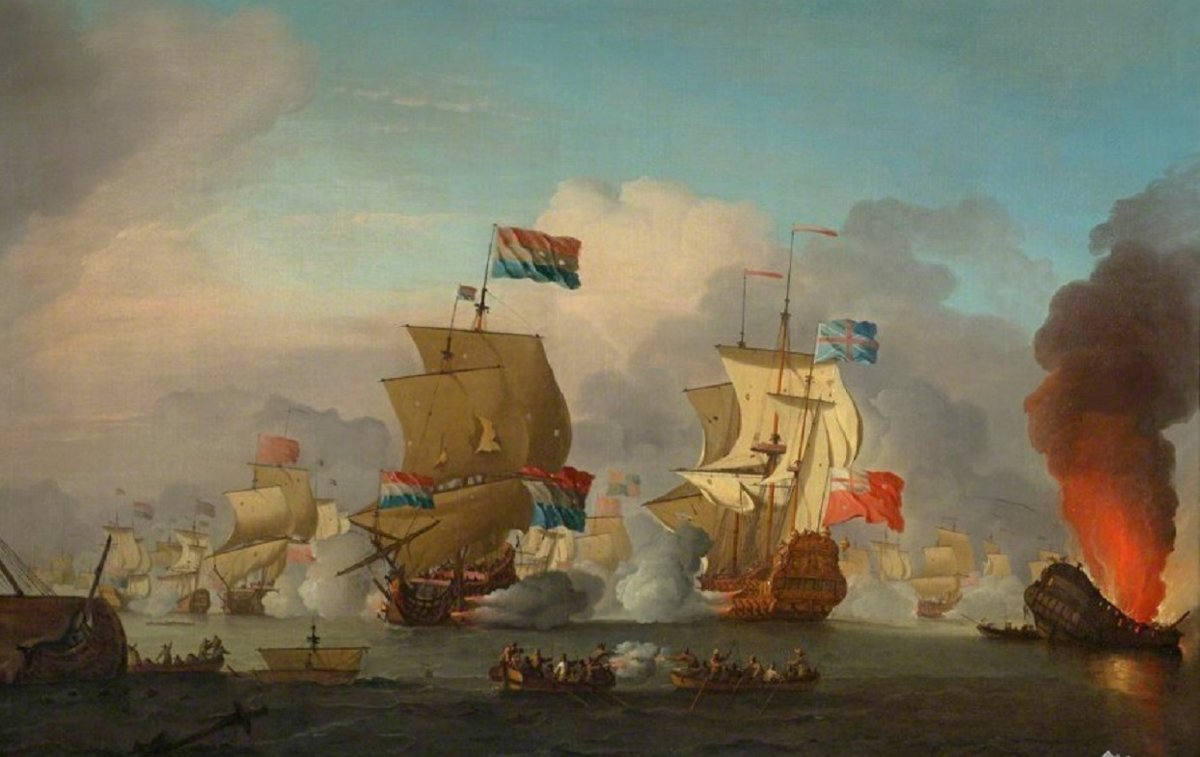 The Burning of the Royal James at the Battle of Solebay, 28 May 1672.The 'Royal James' sank them both but a third fireship, commanded by Jan van de Rijn, grappled the English flagship and set her ablaze. When she was engulfed by the flames Sandwich tried to escape by boat, but it was swamped by people who jumped into her with him and he was drowned. In the left foreground is a Dutch ship sinking, viewed from off the port bow, with only the fore part above the water but with bowsprit and foremast still standing.